 HMT

448 字
2 分钟
pytorch学习09:矩阵基本运算
四则运算
import torch
a = torch.tensor([ [1,2], [3,4]])
b = torch.tensor([ [10, 20]])
# 加print("torch.all(torch.eq(a+b, torch.add(a,b))):", torch.all(torch.eq(a+b, torch.add(a,b))))print("a+b:\n{}\n".format(a+b))
# 减print("torch.all(torch.eq(a-b, torch.sub(a,b))):", torch.all(torch.eq(a-b, torch.sub(a,b))))print("a*b:\n{}\n".format(a-b))
# 乘(是点乘)print("torch.all(torch.eq(a*b, torch.mul(a,b))):", torch.all(torch.eq(a*b, torch.mul(a,b))))print("a*b:\n{}\n".format(a*b))
# 除print("torch.all(torch.eq(a/b, torch.div(a,b))):", torch.all(torch.eq(a/b, torch.div(a,b))))print("a*b:\n{}\n".format(a/b))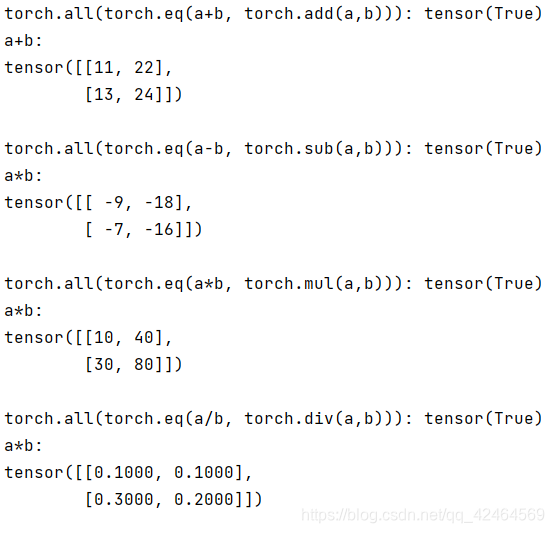
矩阵相乘
import torch
a = torch.tensor([ [1], [3]])
b = torch.tensor([ [10, 20]])
# mm只能运算至多二维矩阵print("torch.mm(a, b):\n{}\n".format(torch.mm(a, b)))# matmul可运算更高维矩阵print("torch.matmul(a, b):\n{}\n".format(torch.matmul(a, b)))print("a@b:\n{}\n".format(a@b))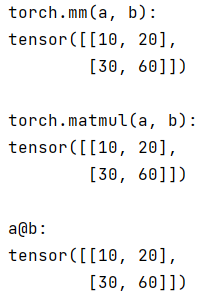
大于2维的矩阵相乘
import torch
a1 = torch.rand(4, 3, 28, 64)b1 = torch.rand(4, 3, 64, 32)
c1 = torch.matmul(a1, b1)# 对最后两维进行乘法运算# 可以理解为多个矩阵并行相乘print("c1.shape: ", c1.shape)
a2 = torch.rand(4, 1, 28, 64)b2 = torch.rand(4, 3, 64, 32)c2 = torch.matmul(a2, b2)# 这里用到了广播机制print("c2.shape: ", c2.shape)
幂运算
import torch
a = torch.tensor([ [1, 2], [3, 4]])
print("a.pow(2):\n{}\n".format(a.pow(2)))print("a**2:\n{}\n".format(a**2))
print("a.pow(0.5):\n{}\n".format(a.pow(0.5)))print("a.sqrt():\n{}\n".format(a.sqrt()))# 平方根的倒数print("a.rsqrt():\n{}\n".format(a.rsqrt()))print("a**0.5:\n{}\n".format(a**0.5))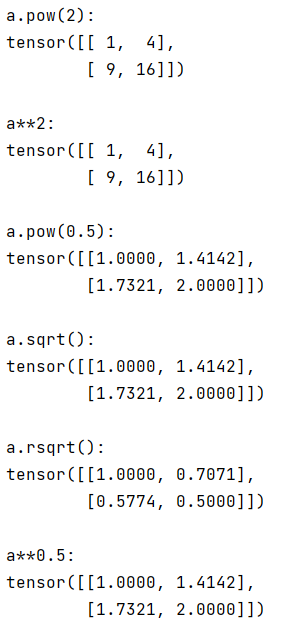
exp log
import torch
a = torch.tensor([ [1, 2], [3, 4]])
a_exp = torch.exp(a)# e^xprint("torch.exp(a):\n{}\n".format(a_exp))# ln x# 以2为底:log2# 以10为底:log10print("torch.log(a_exp):\n{}\n".format(torch.log(a_exp)))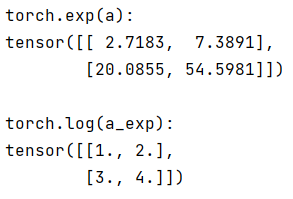
近似值
import torch
a = torch.tensor(1.67)
# 向下取整print("a.floor():", a.floor())# 向上取整print("a.ceil():", a.ceil())# 取整数部分print("a.trunc():", a.trunc())# 取小数部分print("a.frac():", a.frac())# 四舍五入print("a.round():", a.round())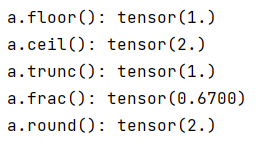
最大值、最小值、中位数
import torch
a = torch.rand(2,3)*20
print("a:\n{}\n".format(a))
# 最大值print("a.max(): ", a.max())# 中位数,偶数时不取平均,取从小到大第 length/2 个print("a.median(): ", a.median())# 最小值print("a.min(): ", a.min())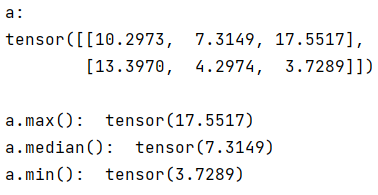
限制区间
import torch
a = torch.rand(2,3)*20
print("a:\n{}\n".format(a))
# clamp(min),当有值小于 min 时,用 min 替换print("a.clamp(10):\n{}\n".format(a.clamp(10)))# clamp(min, max),当有值小于 min 时,用 min 替换# 当有值大于 max 时,用 max 替换print("a.clamp(5, 10):\n{}\n".format(a.clamp(5, 10)))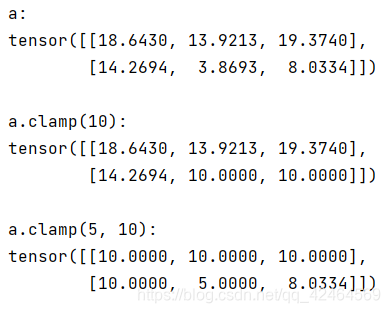
原文链接:CSDN
pytorch学习09:矩阵基本运算
https://blog.homura.work/posts/csdn/119360199/